
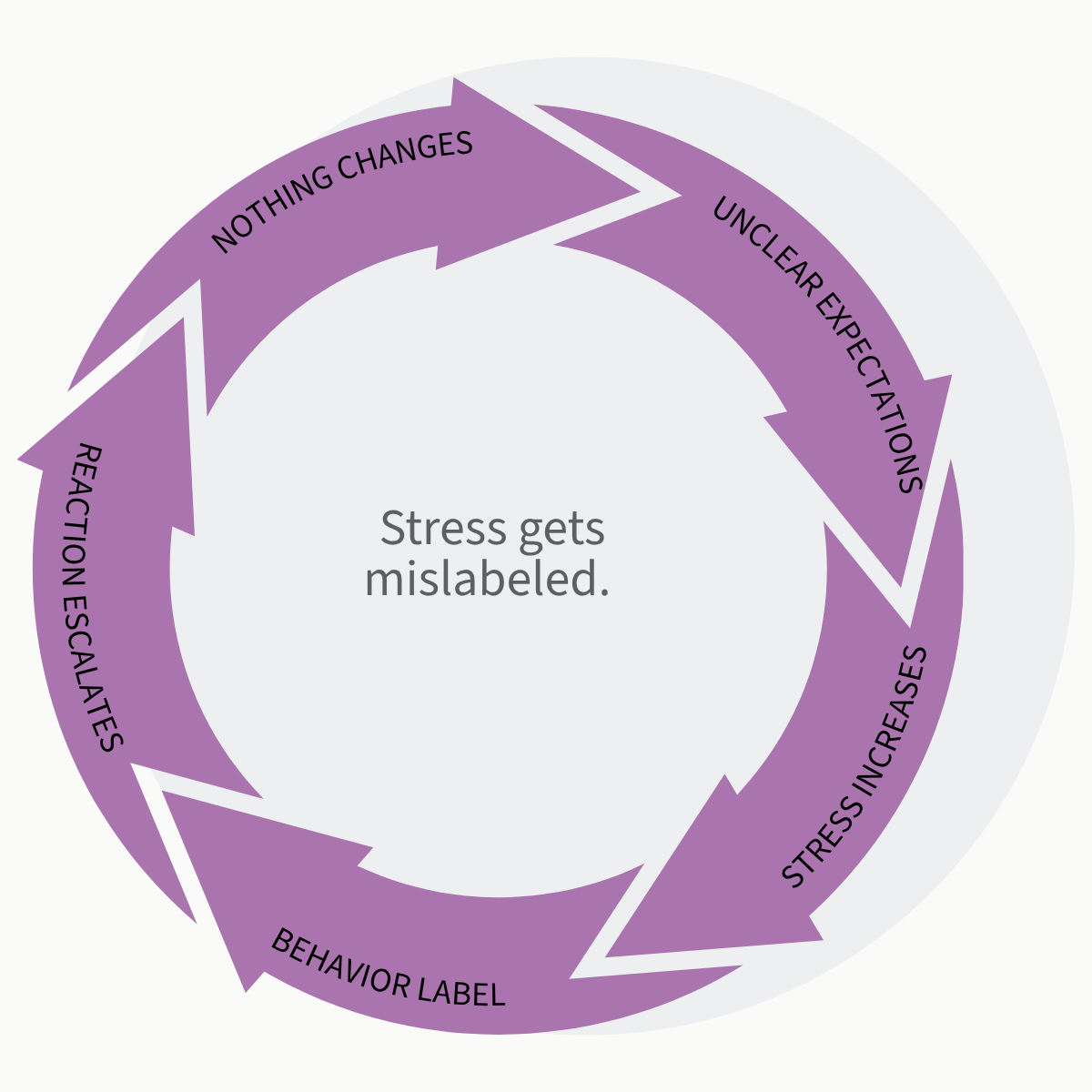
Stress gets misread and mislabeled as behavior.
Compliance gets mistaken for calm.
Defiance gets mistaken for uncertainty.
Performance gets mistaken for capacity.
Quiet gets mistaken for safety.
Meanwhile, people are carrying the cost. Because when environments are confusing, overloaded, or difficult to navigate, everyone has to work harder just to get through the day.
The conversation usually starts with behavior.
The cause often starts somewhere else.
Adults burn out.
Learners disconnect.
Control tightens.
Support slips.
Accessibility vanishes.
People use more energy to manage the confusion they experience.
Then they have nothing left for teaching, learning, or recovering.
Most people don’t need more pressure.
They need environments that make participation easier.
Calm is built.
Clear systems make the cause easier to see.
Responsive language reduces confusion.
People deserve to feel safe.
Routines make participation easier.
Consistency creates stability.
Spaces communicate before adults do.
Good design removes obstacles.
Flexibility leads to independence and resilience.
Support should never feel like a reward.
When students struggle, behavior gets the blame.
Increase predictability.
Improve accessibility.
Strengthen support.
Frameworks, visuals, and reflection supports.
Essays, stories, and systems conversations.
Analyze what’s shaping learners’ experiences.
| Cookie | Duration | Description |
|---|---|---|
| cookielawinfo-checkbox-analytics | 11 months | This cookie is set by GDPR Cookie Consent plugin. The cookie is used to store the user consent for the cookies in the category "Analytics". |
| cookielawinfo-checkbox-functional | 11 months | The cookie is set by GDPR cookie consent to record the user consent for the cookies in the category "Functional". |
| cookielawinfo-checkbox-necessary | 11 months | This cookie is set by GDPR Cookie Consent plugin. The cookies is used to store the user consent for the cookies in the category "Necessary". |
| cookielawinfo-checkbox-others | 11 months | This cookie is set by GDPR Cookie Consent plugin. The cookie is used to store the user consent for the cookies in the category "Other. |
| cookielawinfo-checkbox-performance | 11 months | This cookie is set by GDPR Cookie Consent plugin. The cookie is used to store the user consent for the cookies in the category "Performance". |
| viewed_cookie_policy | 11 months | The cookie is set by the GDPR Cookie Consent plugin and is used to store whether or not user has consented to the use of cookies. It does not store any personal data. |
